English 1303: First Year Writing I
| Dr. Mark Womack | Fall 2014 |
| drmarkwomack@gmail.com | drmarkwomack.com/engl-1303 |
|
Office: Roy Cullen 235 B |
Office Hours: T—F 7:00—8:00 (& by appointment) |
| Time | Section | Room |
| MWF 8:00—9:00 | #12719 | Fred J. Heyne 32 |
| MWF 9:00—10:00 | #12736 | Agnes Arnold Hall 303 |
Textbook
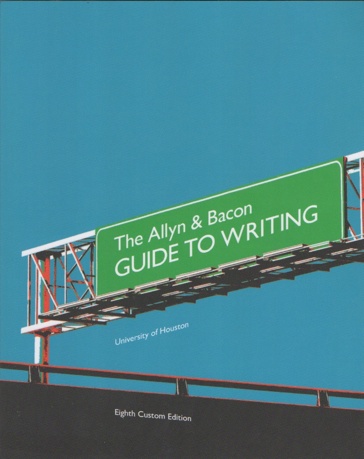
|
Allyn & Bacon Guide to Writing (8th Custom Edition) John D. Ramage, John C. Bean, & June Johnson |
|
Available Exclusively at the University of Houston BOOKSTORE |
|
Materials
- in-class writing tools (pen/pencil & paper)
- a two-pocket folder (for submitting assignments)
- a stapler
Prerequisites
In order to enroll in English 1303 students must meet one of the minimum test scores following: TASP/THEA 240 or TASP/THEA Exempt; TSWE 40; SAT 500 Verbal; ACT 19 Verbal; COMPASS 6; TOEFL 4.5; or PENSSE.
Core Objectives
- Critical Thinking Skills – to include creative thinking, innovation, inquiry, and analysis, evaluation and synthesis of information
- Communication Skills – to include effective development, interpretation and expression of ideas through written, oral and visual communication
- Personal Responsibility – to include the ability to connect choices, actions and consequences to ethical decision-making
- Team Work – to include the ability to consider different points of view and to work effectively with others to support a shared purpose or goal
Academic Support Services
“In compliance with the 1973 Rehabilitation Act and the Americans with Disabilities Act of 1990, the Center for Students with DisABILITIES (CSD) provides ‘reasonable and necessary’ testing accommodations for qualified students with health impairments, physical limitations, psychiatric disorders, and learning disabilities.” Students who want to know more about these services should consult the Student Handbook, or should contact CSD in Room 110 of the Justin Dart, Jr. Center for Students with DisABILITIES (building #568), 713-743-5400 (voice) or 713-749-1527 (TTY); www.uh.edu/csd.
Learning Support Services
For help on the mechanics of papers (grammar, punctuation, and so on.), students should visit Learning Support Services now located in Cougar Village, room N 109.
The Writing Center
For help with developing ideas, thesis development, and so forth, students should visit the University of Houston Writing Center located in 210-217 Agnes Arnold Hall.
Course Policies
Attendance
You should attend all of every class. Excessive Tardies and Absences will affect your grade (see “Professionalism”). Failure to attend constitutes grounds for failing the course. I make no distinction between “excused” and “unexcused” absences; an absence is an absence. (I will excuse religious holidays and University-sponsored activities, but only if you submit written notice to me stating your intention in advance of the absence.) I take roll at the beginning of each class session; if you arrive after roll call, check in with me at the end of class. It is your responsibility to find out, from your classmates, what you missed if you were absent.
Writing Assignments
You will write three Major Essays (a Literacy Narrative, an Informative Essay, and a Synthesis Essay), with required Rough Drafts and Peer Reviews for each. You will also submit ten Writing Exercises, graded Excellent (+), Satisfactory (✓), or Unsatisfactory (−). You must hand in assignments to me at the beginning of class on the day they are due. Papers not submitted directly to me will not receive grades. Failure to complete any assignment, graded or not, may result in a failing grade for the course. I never assign extra credit or make-up work. I discuss grades only in private, and only forty-eight hours (at least) after I have returned an assignment.
Late Assignments
For Major Essays, I deduct ten points from the grade for each class period after the assigned due date you submit it. Late Writing Exercises receive an Unsatisfactory (−) if late by one class period, a zero afterwards. I do not accept Rough Drafts submitted after the Peer Review Workshop. I will give no written comments or feedback on late submissions.
Professionalism
Your grade depends in part on how professionally you behave in class. You should always arrive in class on time with your assignments ready to turn in and your text book in hand; you should have completed the readings for that day and be ready to discuss them intelligently. Professionalism includes all of these as well as regular attendance and a sincere effort to improve your own writing and that of your peers through revision and peer reviews. Every Absence lowers your professionalism grade by five points, every Tardy by one point. Professionalism will often mean the difference between one grade and the next – or, in borderline cases, between passing and failing.
Cell Phones
You may not use cell phones in class. Keep your cell phone turned off and out of sight from the moment the class starts until the moment it ends. Every time I see or hear your cell phone during class, I will deduct ten points from your Professionalism grade. (Notify me before class begins if there is an emergency situation that absolutely requires you to leave your cell phone on.)
Laptops
You may use your laptop or tablet computer only for taking notes, accessing the class website, or other specifically class-related work. If you use it to IM, email, play games, shop or any other such activity during class, you lose ten points from your Professionalism grade and forfeit your right to bring the device to class for the rest of the semester.
Manuscript Requirements
Make and keep a copy of any work turned in for grading. Print out all your assignments on 8 ½ x 11 inch paper. MLA style requires one-inch margins, double spacing, and page numbers. I require you to staple pages together. I will not accept, read, or grade any unstapled papers. Use only readable typefaces (like Century Schoolbook or Palatino). Always print with a good ink cartridge to ensure legibility. I won’t grade papers I consider illegible. Edit and proofread everything you turn in; make every assignment as error-free as you can before you submit it.
Website
I will make all course materials – including the the syllabus, assignment sheets, peer reviews, and so on – available on the class website: https://drmarkwomack.com/engl-1303/.
Academic Dishonesty
The University of Houston Academic Policies define and prohibit academic dishonesty as follows: “‘Academic dishonesty’ means employing a method or technique or engaging in conduct in an academic endeavor that the student knows or should know is not permitted by the university or a course instructor to fulfill academic requirements” (Article 3.02; see Student Handbook URL http://www.uh.edu/dos/hdbk for further details). The primary concern in this course is plagiarism, again defined in the Academic Honesty Policy: “Representing as one’s own work the work of another without acknowledging the source.” I will deal with plagiarism according to its type and severity. Faulty citation of sources is a matter for teaching and revision. Willful and knowing academic dishonesty can – according to University policy – result in a failing grade for the assignment or the course; it may also result in suspension or expulsion from the University.
Course Expectations for Behavior and Preparation
The University of Houston spells out its “Expectations of Students for a Conducive Learning Environment” in the UH Student Handbook, page 64; please review them. The English Department endorses these policies and expects you to abide by them. The handbook is available online at: http://www.uh.edu/dos/publications/handbook.php.
| Assignments | Weight |
| Professionalism | 10% |
| Writing Exercises | 15% |
| Literacy Narrative | 25% |
| Informative Essay | 25% |
| Synthesis Essay | 25% |
| Numerical Values of Letter Grades | ||
| A+ (100-97) | A (96-93) | A- (92-90) |
| B+ (89-87) | B (86-83) | B- (82-80) |
| C+ (79-77) | C (76-73) | C- (72-70) |
| D (69-60) | ||
| F (59-0) | ||
Schedule of Readings & Assignments
| Week One | ||
| M 8/25 | Review of instructions, policies, & syllabus | |
| W 8/27 | Writing Classic Prose | |
| F 8/29 | “Thinking Rhetorically About Good Writing,” Allyn & Bacon Guide to Writing [ABGW] | Two Messages |
| Week Two | ||
| M 9/1 | LABOR DAY | |
| W 9/3 | “Thinking Rhetorically About Your Subject Matter,” ABGW chp. 2 | |
| F 9/5 | “Writing an Autobiographical Narrative,” ABGW chp. 6”¨ | Believing/Doubting |
| Week Three | ||
| M 9/8 | “Composing and Revising Open-Form Prose,” ABGW chp. 11 (Skills 11.1-11.3) | |
| W 9/10 | “Composing and Revising Open-Form Prose,” ABGW chp. 11 (Skills 11.4-11.6) | |
| F 9/12 | Peer Review Workshop | Literacy Narrative Draft |
| Week Four | ||
| M 9/15 | Agent/Action Sentences | |
| W 9/17 | “Thinking Rhetorically About How Messages Persuade,” ABGW chp. 3 | |
| F 9/19 | “Writing as a Problem-Solving Process,” ABGW chp. 9 | Angle of Vision |
| Week Five | ||
| M 9/22 | Revision Workshop: “Revising, Editing, and Proofreading,” ABGW chp. 15 | |
| W 9/24 | Revision Workshop: Writing Concisely | |
| F 9/26 | Assignment for Essay 2 | Literacy Narrative Revised |
| Week Six | ||
| M 9/29 | “Writing an Informative Essay or Report,” ABGW chp. 7 | |
| W 10/1 | “Why We Crave Horror Movies” (link) Copyright1981! | |
| F 10/3 | “Composing and Revising Closed-Form Prose,” ABGW chp. 10 (Skills 10.1-10.4) | |
| Week Seven | ||
| M 10/6 | “Composing and Revising Closed-Form Prose,” ABGW chp. 10 (Skills 10.5-10.10) | |
| W 10/8 | “Thinking Rhetorically About Style & Document Design,” ABGW chp. 4 | |
| F 10/10 | “Incorporating Sources Into Your Own Writing” ABGW chp. 12 | Contrasting Descriptions |
| Week Eight | ||
| M 10/13 | “Citing and Documenting Sources” ABGW chp. 13 | |
| W 10/15 | “Using Sources and Avoiding Plagarism” ABGW chp. 14 | |
| F 10/17 | Peer Review Workshop | Informative Essay Draft |
| Week Nine | ||
| M 10/20 | “Politics and the English Language” (link) | |
| W 10/22 | “Typography in Ten Minutes” (link) “Research Papers” (link) |
|
| F 10/24 | LaTeX default margins (link) What Font Should I Use? (link) |
Creative Imitation |
| Week Ten | ||
| M 10/27 | Revision Workshop: “Punctuation,” ABGW chp. 17 | |
| W 10/29 | Revision Workshop: MLA Format | |
| F 10/31 | Assignment for Essay 3 [Last Day to drop a course or withdraw with a “W”] |
Informative Essay Revised |
| Week Eleven | ||
| M 11/3 | “Analyzing and Synthesizing Ideas,” ABGW chp. 8 | |
| W 11/5 | “Reading Rhetorically: The Writer as Strong Reader,” ABGW chp. 5 | |
| F 11/7 | Summarizing Your Texts | Summary Writing |
| Week Twelve | ||
| M 11/10 | Examining the Rhetorical Strategies of Your Texts | Rhetorical Strategies |
| W 11/12 | Generating Points About Themes, Shared Ideas, and Differences | Similarities & Differences |
| F 11/14 | Developing Your Own Views | Generating Ideas |
| Week Thirteen | ||
| M 11/17 | Generating Your Synthesis Points | Your Synthesis |
| W 11/19 | Synthesis Essay Draft Workshop | |
| F 11/21 | Peer Review Workshop | Synthesis Essay Draft |
| Week Fourteen | ||
| M 11/24 | Synthesis Essay Workshop | |
| W 11/26 | THANKSGIVING HOLIDAY | |
| F 11/28 | ||
| Week Fifteen | ||
| M 12/1 | Revision Workshop | |
| W 12/3 | Revision Workshop | |
| F 12/5 | Synthesis Essay Revised | |
Your instructor, Mark Womack, reserves the right to amend any policies listed here with sufficient written and verbal notice.